The Last Counter Between Prescription and Patient: When a Pharmacist Declines to Fill an Unapproved Pain Drug
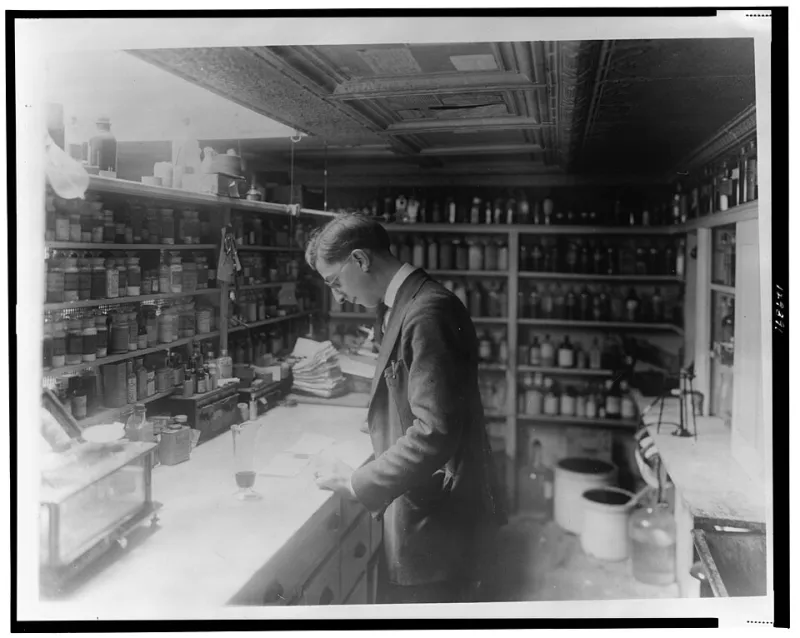
Photo: National Photo Company Collection, Public domain, via Wikimedia Commons
In the American medication system, most prescriptions travel an unremarkable path: physician to pharmacy to patient, with barely a pause at each step. But a small and consequential class of prescriptions breaks that rhythm. When a clinician writes for an investigational compound — say, a nerve growth factor inhibitor that never completed its regulatory journey — the transaction often stalls at the pharmacy counter, and the person standing behind it must make a decision that is part legal judgment, part clinical ethics, and part professional conscience.
The pharmacist's refusal is rarely dramatic. It is usually a quiet conversation, a phone call to the prescriber, a note in the dispensing record. Yet these moments reveal something important about how the US drug system actually polices itself — and why the last line of defense is frequently not a regulator or a hospital committee, but a licensed professional with a state board behind them and a patient in front of them.
The Legal Architecture of a Refusal
Pharmacists in the United States operate under a framework that is easy to overlook precisely because it is so routine. Every state grants pharmacists a corresponding duty: the obligation to independently verify that a prescription is appropriate before dispensing it. This is not a courtesy check. It is a statutory responsibility, and in most states it carries the same professional weight as the prescribing decision itself.
That duty has teeth. A pharmacist who dispenses a medication that lacks a lawful basis — no approved indication, no legitimate compounding rationale, no enrollment in an investigational protocol — can face action from the state board of pharmacy, civil liability, and, in the most serious cases, criminal exposure under the federal Food, Drug, and Cosmetic Act. Conversely, a pharmacist who refuses to fill a lawful prescription without adequate grounds risks professional discipline and, increasingly, litigation from frustrated patients.
The legal gray zone lives in the middle. Off-label prescribing is lawful in the United States; a physician may prescribe an approved drug for an unapproved use. What is not lawful is promoting an unapproved use, or dispensing a product that was never approved at all. So when a prescription arrives for a compound like tanezumab — a monoclonal antibody that was studied in Phase III osteoarthritis trials but never received FDA approval — the pharmacist is not navigating an off-label question. They are navigating a question of whether the product can lawfully be dispensed to this patient through any channel at all.
Three Questions at the Counter
When an unusual pain-drug prescription lands in the queue, a practicing pharmacist is effectively running through a structured inquiry. The first question is one of product identity: what, exactly, is in the vial or the syringe? Investigational monoclonal antibodies are not sitting in wholesale distributors' catalogs. If a pharmacy receives an order for one, the source matters enormously — a compounding operation, an overseas supplier, or a clinic with its own stock each carry different regulatory implications.
The second question is one of authority. Is this prescription tied to an active clinical trial, an expanded access protocol, or a right-to-try pathway? Investigational drugs reach patients through narrow, documented channels, each requiring institutional oversight, informed consent, and specific labeling. A prescription that arrives stripped of that context — just a drug name and a sig — cannot be verified against any protocol, and verification is precisely what the corresponding duty demands.
The third question is one of patient safety, and it is where the pharmacist's clinical training earns its keep. NGF-targeting compounds carry a documented history of joint safety concerns, including rapidly progressive osteoarthritis identified in trial imaging sub-studies. A pharmacist who understands this history may reasonably conclude that dispensing such a product outside monitored conditions exposes the patient to risks that no one is tracking — no adjudication committee, no imaging schedule, no safety reporting structure.
Conscience, Compulsion, and the Limits of Either
The ethics of refusal are more contested than the law. Conscience clauses in most states protect pharmacists who decline to dispense on moral grounds — most visibly in the context of reproductive health — and several states impose obligations to refer or ensure continuity of care. But refusing an unapproved investigational drug is categorically different from a conscientious objection. It is not a clash of values; it is an exercise of the professional judgment the license exists to provide.
That distinction matters for patients, too. A patient who has heard about a trial compound from a news article or an online forum may experience a pharmacist's refusal as gatekeeping — one more barrier between them and relief from chronic pain. The empathy is legitimate. Chronic pain patients in the United States navigate prior authorizations, formulary exclusions, and pharmacy deserts as a matter of course. But the refusal to dispense an unverified investigational product is not part of that pattern of obstruction. It is the system acknowledging that a drug which never survived its regulatory review should not re-enter circulation through the back door.
The most constructive refusals share a common feature: they come with alternatives. A pharmacist who declines to fill a gray-market compound but takes five minutes to explain expanded access pathways, connect the patient with the prescriber, or flag legitimate clinical trial enrollment options has converted a refusal into a redirect. The prescription still doesn't get filled. The patient, however, leaves with something more durable than a vial — an accurate map of what is and is not legally available.
What the Counter Teaches the System
For researchers and regulators, pharmacist refusals are an underexamined data source. They mark the points where demand for unavailable therapies meets supply-side reality, and they surface patterns — which compounds patients are requesting, which prescribers are writing for them, which compounding suppliers are circulating — long before adverse event databases register a signal. A cluster of refusals in one region can be an early warning that an informal distribution network has taken root.
For clinicians, the lesson is simpler. A prescription is not a transaction; it is a claim that a specific product, at a specific dose, is appropriate for a specific patient. When that claim cannot be substantiated — because the product is unapproved, the source is unverifiable, and the safety monitoring is nonexistent — the pharmacist's no is not an obstacle to care. It is care, delivered in the least glamorous setting in American medicine: a counter, a conversation, and a professional willing to bear the discomfort of saying wait.
The investigational compounds that fail in trials often leave behind a shadow demand. The pharmacists who absorb that demand, one declined prescription at a time, are performing a regulatory function that no statute explicitly assigns them. It is worth recognizing that function for what it is — and worth ensuring that when they say no, someone is positioned to help patients find the yes that actually exists.